

World Economic Forum Articles
NEED MINI SPONSOR LOGO

Women’s Network news roundup: gender parity 123 years away, and more
In this latest collection, we report on news that the world is 123 years from reaching gender parity by the World Economic Forum’s estimate, on why backlash against gender equality threatens multilateral efforts on climate change, on South Africa’s protocol on inclusive trade, and more. Join: Find out more and become a member of the Global…

UK publishes new generative AI guidance for civil servants; Gender equity alliance launched at Davos: news in brief
Global Government Forum’s digest of the news you need to know but might have missed. UK publishes new generative AI guidance for civil servants The UK government’s Central Digital and Data Office has updated guidance on the use of AI by departments and agencies, emphasising 10 principles officials should keep in mind when working on…

Governments doing too little on climate change, say citizens
More than half of global citizens believe governments are doing too little to address climate change, according to a new study from the World Economic Forum (WEF). The Climate Progress Survey: Business & Consumer Worries & Hopes, produced by WEF in partnership with SAP and Qualtrics, gathered insights from 11,000 people in 28 countries. It…

Economic Outlook 2022: What the data says about the risks and responses needed to capture emerging opportunities
For nearly two years, the pandemic has obscured the global outlook, making traditional long-term economic planning for governments challenging. While a vaccine-led vision for re-emerging formed intermittently across the world, we’ve learned progress is fragile as variants arise and risks remain. An early casualty of the ongoing pandemic in 2022 was the World Economic Forum…

COP26: Governments must do more to help businesses tackle climate change, CEOs say
Policymakers must work more closely with corporates if countries are to achieve net-zero greenhouse gas emissions, a group of more than 90 CEOs has said as world leaders arrive in Glasgow for the COP26 climate change summit. The Alliance of CEO Climate Leaders – which represents some of the world’s biggest companies including Microsoft, Allianz,…

South African president condemns COVID procurements corruption
South African president Cyril Ramaphosa has condemned corruption in the ruling African National Congress (ANC) party related to the procurement of COVID-19 equipment, and suggested addressing the problem through transparency, public engagement and digital tools. In a letter sent to ANC members last weekend, president Ramaphosa said there is a “sense of anger and disillusionment…

World Economic Forum launches roadmap for safe cross-border data flows
The World Economic Forum (WEF) has launched a “roadmap” to encourage policymakers and governments to legislate for safe data-sharing practices across international borders. Developed in partnership with the Bahrain Economic Development Board, the Roadmap for Cross-Border Data Flows, published on 9 June, sets out a series of recommendations drawing on best practice around the world.…

Central banks pool brainpower on digital currencies
A group of the world’s most influential central banks have teamed up to pool expertise on central bank digital currencies. The Bank of Canada, the Bank of England (BoE), the Bank of Japan, the Sveriges Riksbank (Sweden) and the Swiss National Bank, together with the European Central Bank (ECB) and the Bank for International Settlements…
World Economic Forum Events, Conferences & Summits - In-Person


World Economic Forum Webinars




World Economic Forum Research
Discover independent research reports, surveys and in-depth studies from Global Government Forum and knowledge partners, exploring the most important issues facing governments and the public sector. Our research provides practical insights and evidence-based recommendations for senior civil servants, policymakers and public sector leaders. Our reports combine exclusive survey data, expert analysis and interviews with government leaders from around the world to help public sector organisations improve performance, inform policy and deliver better outcomes for citizens.
Empowering Public Servants to Make Confident, Informed Decisions with Data and AI
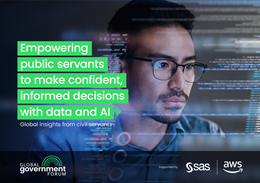
Governments around the world are working hard to extract – and act upon – the insights held in their vast data stores, and to embrace AI and the promise it holds for innovation and transformation. At the same time, economic pressures and constrained budgets are compelling public servants to do more with fewer resources, while governments are called to respond quickly and effectively to complex challenges.
Against this backdrop, data and AI can help those working in government both to streamline their workflows and make fast, informed decisions. This in turn drives efficiency and can unlock productivity gains – and ultimately lead to improved performance and better services for citizens.
Global Government Forum surveyed over 600 civil servants worldwide to understand how data and AI are being used in government decision-making and where there are further challenges and opportunities.
Read this report for insight into how governments are using data and AI in decision-making today and the potential for the future; the major challenges to using data and AI in decision-making and how to overcome them; and how AI agents can be used in decision-making.
The report includes examples of data and AI in decision-making from countries including the UK, Ireland, Australia, Canada, Singapore, the US, and more.
(Published September 2025)
Making Government Work: Five Pillars of a Modern, Effective Civil Service

Around the world, governments are dealing with substantial challenges – from economic stagnation to the transition to net zero, military conflicts and cyber threats. Governments are also grappling with shifting geopolitics and the rise of populism – and all of these factors are set against the emergence of new technologies, including generative AI, which have the potential to fundamentally transform every aspect of society, but which also pose huge ethical, security and regulatory questions for the public sector.
The Making Government Work: Five pillars of a modern, effective civil service report was undertaken to help identify the key characteristics needed in a modern public service, with priorities ranging across leadership, digital service delivery, workforce development, cross-departmental integration, and citizen trust.
This report has been covered by publications around the world including the Financial Times, BBC Radio 4’s PM programme, Ottawa Citizen, Fed Manager, the Mandarin and the i newspaper.
(Published August 2024)
The Future of the Finance Ministry

From setting tax rates and financial regulations that create the ground rules for national economies, to allocating – and tracking – spending for public services, finance ministries occupy an essential role at the centre of government. Geopolitical crises have reinforced the importance of finance ministries, as they tackle both immediate shocks and long-term trends such as ageing populations, the digital transition, and the impact of moves to net zero.
Against this backdrop, this global research explores what the future finance ministry looks like and how to prepare for it.
Based on interviews with 10 senior leaders from finance ministries – led by John McCarthy, chief economist in Ireland’s Department of Finance, working with Ian Hall, editor, Global Government Finance, and Richard Johnstone, executive editor, Global Government Forum – the study identifies four key themes: the evolving role of the finance ministry in response to uncertainty; the shift to more flexible finance systems that support outcomes; digital transformation and the growth of AI; and the battle for talent and trust.
(Published May 2026)
World Economic Forum Training Courses


Partnerships
Partner with us to connect with senior government leaders, policymakers, public sector professionals and the organisations shaping the future of AI in public services.
Our partnership opportunities are designed to facilitate meaningful collaboration, knowledge sharing and engagement across the public sector. Whether you are a government department, local authority, public body or industry organisation, we help you share expertise, showcase innovation and contribute to the responsible adoption of AI across public services.
Join the World Economic Forum Community
Be part of the growing community shaping the future of AI across government and the public sector.
Sign up to receive the latest AI news, research, events, webinars and practical insights from GGF and our partners. You'll be the first to hear about new reports, conferences, networking opportunities and thought leadership from government and industry experts.
Latest News


