

technnology Articles
NEED MINI SPONSOR LOGO

Overcoming AI bias to empower an equitable society
Reasoning frameworks of artificial intelligence used in criminal justice and health care systems move us to rethink how AI can be constructed to help foster an equitable society. We interact daily with algorithms that over time predict and inform our actions. Spam filters in e-mail and real-time mapping technologies on our cell phones are two examples of technologies that…

Making artificial intelligence fit for a life inside government
Move fast and break things; reward risk-taking; scale fast. These three credos have allowed technology companies to upend our everyday lives in the past two decades, while producing fortunes for their owners. Civil servants are equally passionate about transforming society, but – given their responsibility to spend taxpayers’ money carefully and serve everyone in society…

Human rights and AI: interesting insights from Australia’s commission
The conundrum is one that many governments face: how do you make the most of technological advances in areas such as artificial intelligence (AI) while protecting people’s rights? This applies to government as both a user of the tech and a regulator with a mandate to protect the public. Australia’s Human Rights Commission recently undertook…

AI could scale up disinformation campaigns, researchers warn
Hostile actors could use automation to launch highly scalable disinformation campaigns with less manpower than is currently required, researchers have warned. A new report – Truth, Lies and Automation – analysed how GPT-3, an artificial intelligence (AI) system that writes text, could be used in disinformation campaigns. The researchers concluded that “although GPT-3 will not…

A closer look at Singapore’s AI governance framework: insights for other governments
As officials across the world work to establish AI ethics codes, Amit Roy Choudhury argues that Singapore’s system provides a model for others at a time when common global standards are emerging Governments around the world are rushing to formulate risk- and rules-based approaches to ensuring transparent and fair use of artificial intelligence (AI). Both…

Time traveller: Israeli IT chief Shahar Bracha on digital’s leap into the future
The pandemic has supercharged progress on Israel’s digital services, says the head of its Government ICT Authority – and cleared the path ahead for radical reforms to create corporate IDs and dismantle legislative obstacles. Matt Ross interviews Shahar Bracha “We moved four or five years into the future due to this pandemic,” says Shahar Bracha,…

How data analytics can help governments recruit and retain talent
Data tools can provide invaluable insights to help both department leaders with their strategic workforce needs, and team managers to effectively support and develop individuals Management is a people business so it’s always helpful to have a comprehensive picture of your staff. To recruit, develop and support staff, team managers need a deep understanding of…

Emotion recognition tech fundamentally flawed, says human rights charity
Emerging AI-based emotion recognition technologies are “untenable” under international human rights law, and developing, designing or sharing such tech should be banned, a recent report has argued. The study, which focused on the growing use of emotion recognition technologies by state and corporate bodies in China, was published in January this year by Article 19,…
technnology Events, Conferences & Summits - In-Person


technnology Webinars




technnology Research
Discover independent research reports, surveys and in-depth studies from Global Government Forum and knowledge partners, exploring the most important issues facing governments and the public sector. Our research provides practical insights and evidence-based recommendations for senior civil servants, policymakers and public sector leaders. Our reports combine exclusive survey data, expert analysis and interviews with government leaders from around the world to help public sector organisations improve performance, inform policy and deliver better outcomes for citizens.
Empowering Public Servants to Make Confident, Informed Decisions with Data and AI
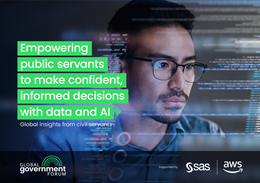
Governments around the world are working hard to extract – and act upon – the insights held in their vast data stores, and to embrace AI and the promise it holds for innovation and transformation. At the same time, economic pressures and constrained budgets are compelling public servants to do more with fewer resources, while governments are called to respond quickly and effectively to complex challenges.
Against this backdrop, data and AI can help those working in government both to streamline their workflows and make fast, informed decisions. This in turn drives efficiency and can unlock productivity gains – and ultimately lead to improved performance and better services for citizens.
Global Government Forum surveyed over 600 civil servants worldwide to understand how data and AI are being used in government decision-making and where there are further challenges and opportunities.
Read this report for insight into how governments are using data and AI in decision-making today and the potential for the future; the major challenges to using data and AI in decision-making and how to overcome them; and how AI agents can be used in decision-making.
The report includes examples of data and AI in decision-making from countries including the UK, Ireland, Australia, Canada, Singapore, the US, and more.
(Published September 2025)
Making Government Work: Five Pillars of a Modern, Effective Civil Service

Around the world, governments are dealing with substantial challenges – from economic stagnation to the transition to net zero, military conflicts and cyber threats. Governments are also grappling with shifting geopolitics and the rise of populism – and all of these factors are set against the emergence of new technologies, including generative AI, which have the potential to fundamentally transform every aspect of society, but which also pose huge ethical, security and regulatory questions for the public sector.
The Making Government Work: Five pillars of a modern, effective civil service report was undertaken to help identify the key characteristics needed in a modern public service, with priorities ranging across leadership, digital service delivery, workforce development, cross-departmental integration, and citizen trust.
This report has been covered by publications around the world including the Financial Times, BBC Radio 4’s PM programme, Ottawa Citizen, Fed Manager, the Mandarin and the i newspaper.
(Published August 2024)
The Future of the Finance Ministry

From setting tax rates and financial regulations that create the ground rules for national economies, to allocating – and tracking – spending for public services, finance ministries occupy an essential role at the centre of government. Geopolitical crises have reinforced the importance of finance ministries, as they tackle both immediate shocks and long-term trends such as ageing populations, the digital transition, and the impact of moves to net zero.
Against this backdrop, this global research explores what the future finance ministry looks like and how to prepare for it.
Based on interviews with 10 senior leaders from finance ministries – led by John McCarthy, chief economist in Ireland’s Department of Finance, working with Ian Hall, editor, Global Government Finance, and Richard Johnstone, executive editor, Global Government Forum – the study identifies four key themes: the evolving role of the finance ministry in response to uncertainty; the shift to more flexible finance systems that support outcomes; digital transformation and the growth of AI; and the battle for talent and trust.
(Published May 2026)


Partnerships
Partner with us to connect with senior government leaders, policymakers, public sector professionals and the organisations shaping the future of AI in public services.
Our partnership opportunities are designed to facilitate meaningful collaboration, knowledge sharing and engagement across the public sector. Whether you are a government department, local authority, public body or industry organisation, we help you share expertise, showcase innovation and contribute to the responsible adoption of AI across public services.
Join the technnology Community
Be part of the growing community shaping the future of AI across government and the public sector.
Sign up to receive the latest AI news, research, events, webinars and practical insights from GGF and our partners. You'll be the first to hear about new reports, conferences, networking opportunities and thought leadership from government and industry experts.
Latest News


