

payments Articles
NEED MINI SPONSOR LOGO

How US governments are streamlining payments processes
During this webinar, public and private sector panellists discussed how US city and state governments are modernising disbursements – and the tangible benefits for citizens and authorities The development of digital tools and services has made many areas of people’s daily lives considerably more convenient – but systems in government often lag the private…

UK government launches GOV.UK digital services app for smartphones
The UK government has launched the first version of its GOV.UK app to provide citizens with digital access to government services and benefits. The app’s initial release to British citizens aged 16 and over yesterday (1 July) marks what the Government Digital Service (GDS) described in a statement as “an overhaul to the experience…

Interview: why e-payments are a ‘game changer’ for digital public services in Italy
PagoPA is best known in Italy for its payments platform but the state-owned organisation also plays a wider role in driving digital public services. CEO Alessandro Moricca speaks to Ian Hall. Italy is doing things differently when it comes to encouraging the adoption of digital payments and digital public services more broadly. Leading the charge…

Ireland’s financial services minister to speak at Global Government Fintech Lab 2023
Ireland’s minister of state with responsibility for financial services is to speak at the Global Government Fintech Lab 2023, being hosted in Dublin on Thursday 18 May. Jennifer Carroll MacNeill will deliver the opening keynote at the Lab – an international event organised by our sister title Global Government Fintech for senior public servants interested…

Canadian government races to collect Phoenix overpayments as deadline looms
Canada’s federal government is racing to recoup an estimated C$552m (US$433m) in overpayments made to employees as a result of the botched Phoenix pay system before they must be written off by law. The centralised system for processing public service salaries was introduced in 2016. Since then, a series of technical problems and flawed record…

The top five threats to government procurement integrity
Government procurement teams are responsible for managing billions of pounds of public expenditure, and taxpayers want more transparency on how their money is being spent. However, experts estimate that procurement errors, waste and abuse can cost central government up to 4.7% of procurement spend. And when government procurement fraud scandals hit the press, the damage to public…

HMRC explores the potential of open banking to ‘streamline’ tax
The UK’s HM Revenue & Customs (HMRC) is investigating how it can use small businesses’ and self-employed individuals’ real-time financial transaction data, obtained with their permission through open banking, to calculate and collect tax. The department issued a request for information (RFI) on “tax-compliant banking products” last week. This is the latest signal that the…

Singapore grants non-banks access to e-payments infrastructure
Singapore’s central bank is opening up its retail payments infrastructure to non-banks from February 2021 to simplify e-payments for consumers and businesses. The Monetary Authority of Singapore (MAS) announced on Monday that non-bank financial institutions (NFIs) licenced as “major payment institutions” under Singapore’s Payment Services Act will be eligible. This means they have passed checks in areas…
payments Events, Conferences & Summits - In-Person


payments Webinars




payments Research
Discover independent research reports, surveys and in-depth studies from Global Government Forum and knowledge partners, exploring the most important issues facing governments and the public sector. Our research provides practical insights and evidence-based recommendations for senior civil servants, policymakers and public sector leaders. Our reports combine exclusive survey data, expert analysis and interviews with government leaders from around the world to help public sector organisations improve performance, inform policy and deliver better outcomes for citizens.
Empowering Public Servants to Make Confident, Informed Decisions with Data and AI
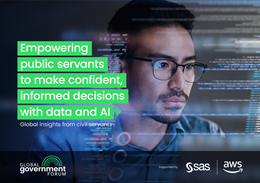
Governments around the world are working hard to extract – and act upon – the insights held in their vast data stores, and to embrace AI and the promise it holds for innovation and transformation. At the same time, economic pressures and constrained budgets are compelling public servants to do more with fewer resources, while governments are called to respond quickly and effectively to complex challenges.
Against this backdrop, data and AI can help those working in government both to streamline their workflows and make fast, informed decisions. This in turn drives efficiency and can unlock productivity gains – and ultimately lead to improved performance and better services for citizens.
Global Government Forum surveyed over 600 civil servants worldwide to understand how data and AI are being used in government decision-making and where there are further challenges and opportunities.
Read this report for insight into how governments are using data and AI in decision-making today and the potential for the future; the major challenges to using data and AI in decision-making and how to overcome them; and how AI agents can be used in decision-making.
The report includes examples of data and AI in decision-making from countries including the UK, Ireland, Australia, Canada, Singapore, the US, and more.
(Published September 2025)
Making Government Work: Five Pillars of a Modern, Effective Civil Service

Around the world, governments are dealing with substantial challenges – from economic stagnation to the transition to net zero, military conflicts and cyber threats. Governments are also grappling with shifting geopolitics and the rise of populism – and all of these factors are set against the emergence of new technologies, including generative AI, which have the potential to fundamentally transform every aspect of society, but which also pose huge ethical, security and regulatory questions for the public sector.
The Making Government Work: Five pillars of a modern, effective civil service report was undertaken to help identify the key characteristics needed in a modern public service, with priorities ranging across leadership, digital service delivery, workforce development, cross-departmental integration, and citizen trust.
This report has been covered by publications around the world including the Financial Times, BBC Radio 4’s PM programme, Ottawa Citizen, Fed Manager, the Mandarin and the i newspaper.
(Published August 2024)
The Future of the Finance Ministry

From setting tax rates and financial regulations that create the ground rules for national economies, to allocating – and tracking – spending for public services, finance ministries occupy an essential role at the centre of government. Geopolitical crises have reinforced the importance of finance ministries, as they tackle both immediate shocks and long-term trends such as ageing populations, the digital transition, and the impact of moves to net zero.
Against this backdrop, this global research explores what the future finance ministry looks like and how to prepare for it.
Based on interviews with 10 senior leaders from finance ministries – led by John McCarthy, chief economist in Ireland’s Department of Finance, working with Ian Hall, editor, Global Government Finance, and Richard Johnstone, executive editor, Global Government Forum – the study identifies four key themes: the evolving role of the finance ministry in response to uncertainty; the shift to more flexible finance systems that support outcomes; digital transformation and the growth of AI; and the battle for talent and trust.
(Published May 2026)


Partnerships
Partner with us to connect with senior government leaders, policymakers, public sector professionals and the organisations shaping the future of AI in public services.
Our partnership opportunities are designed to facilitate meaningful collaboration, knowledge sharing and engagement across the public sector. Whether you are a government department, local authority, public body or industry organisation, we help you share expertise, showcase innovation and contribute to the responsible adoption of AI across public services.
Join the payments Community
Be part of the growing community shaping the future of AI across government and the public sector.
Sign up to receive the latest AI news, research, events, webinars and practical insights from GGF and our partners. You'll be the first to hear about new reports, conferences, networking opportunities and thought leadership from government and industry experts.
Latest News


