

Payments & Financial Services Articles
NEED MINI SPONSOR LOGO

Economic Outlook 2022: What the data says about the risks and responses needed to capture emerging opportunities
For nearly two years, the pandemic has obscured the global outlook, making traditional long-term economic planning for governments challenging. While a vaccine-led vision for re-emerging formed intermittently across the world, we’ve learned progress is fragile as variants arise and risks remain. An early casualty of the ongoing pandemic in 2022 was the World Economic Forum…

Governments look to fintech revolution to drive financial inclusion
Digital advances are providing governments with unprecedented opportunities to improve rates of financial inclusion through fintech-driven programmes and solutions. This was the view of senior state authority representatives from Colombia, India, Brazil and Azerbaijan during an international webinar exploring how fintech-driven innovation – which has accelerated worldwide during the global pandemic – is helping governments…

Lithuania showcases regtech prototype amid focus on anti-money laundering efforts
Lithuania’s central bank, Lietuvos Bankas, showcased a new regulatory technology (regtech) protoype this week that automates reporting procedures, cutting the administrative burden for financial market participants. The prototype – developed by two IT companies, Columbus Lietuva and Peekdata – uses an application programming interface (API) that financial institutions can install. This automatically collects the required…

Reset, Rebuild, Recover – leveraging digital technologies to respond to the social and economic impact of COVID-19
Across the world, the economic stimulus response to COVID-19 far outsize those to the 2008 financial crisis – 33 percent of Gross Domestic Product (GDP) versus 3.5 percent of GDP in Germany – and the U.S. Federal Reserve’s balance sheet grew as much in six months as over the prior 12 years. The pandemic has…

UK international trade department unveils fintech match-making initiative
The UK’s Department for International Trade (DIT) has launched a campaign to encourage international financial institutions (IFIs) to invest in British fintech. As part of the scheme, DIT will build a platform to help fintechs “connect with and advance commercial dialogue with IFIs” including asset managers, insurance and investment companies and banks. This “global ecosystem”…

HMRC explores the potential of open banking to ‘streamline’ tax
The UK’s HM Revenue & Customs (HMRC) is investigating how it can use small businesses’ and self-employed individuals’ real-time financial transaction data, obtained with their permission through open banking, to calculate and collect tax. The department issued a request for information (RFI) on “tax-compliant banking products” last week. This is the latest signal that the…

Singapore grants non-banks access to e-payments infrastructure
Singapore’s central bank is opening up its retail payments infrastructure to non-banks from February 2021 to simplify e-payments for consumers and businesses. The Monetary Authority of Singapore (MAS) announced on Monday that non-bank financial institutions (NFIs) licenced as “major payment institutions” under Singapore’s Payment Services Act will be eligible. This means they have passed checks in areas…

Tallinn tales: Estonia’s role in developing the digital euro
Rainer Olt is leading research on digital currency technology for Estonia’s central bank. In an interview with Ian Hall, he talks blockchain, privacy and instant payments Estonia boasts a well-forged reputation both as an e-government pioneer and for punching above its weight in the European Union (EU). So recent news that its central bank Eesti Pank is supporting…
Payments & Financial Services Events, Conferences & Summits - In-Person


Payments & Financial Services Webinars




Payments & Financial Services Research
Discover independent research reports, surveys and in-depth studies from Global Government Forum and knowledge partners, exploring the most important issues facing governments and the public sector. Our research provides practical insights and evidence-based recommendations for senior civil servants, policymakers and public sector leaders. Our reports combine exclusive survey data, expert analysis and interviews with government leaders from around the world to help public sector organisations improve performance, inform policy and deliver better outcomes for citizens.
Empowering Public Servants to Make Confident, Informed Decisions with Data and AI
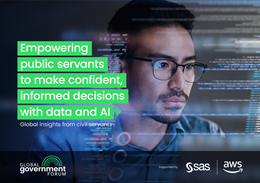
Governments around the world are working hard to extract – and act upon – the insights held in their vast data stores, and to embrace AI and the promise it holds for innovation and transformation. At the same time, economic pressures and constrained budgets are compelling public servants to do more with fewer resources, while governments are called to respond quickly and effectively to complex challenges.
Against this backdrop, data and AI can help those working in government both to streamline their workflows and make fast, informed decisions. This in turn drives efficiency and can unlock productivity gains – and ultimately lead to improved performance and better services for citizens.
Global Government Forum surveyed over 600 civil servants worldwide to understand how data and AI are being used in government decision-making and where there are further challenges and opportunities.
Read this report for insight into how governments are using data and AI in decision-making today and the potential for the future; the major challenges to using data and AI in decision-making and how to overcome them; and how AI agents can be used in decision-making.
The report includes examples of data and AI in decision-making from countries including the UK, Ireland, Australia, Canada, Singapore, the US, and more.
(Published September 2025)
Making Government Work: Five Pillars of a Modern, Effective Civil Service

Around the world, governments are dealing with substantial challenges – from economic stagnation to the transition to net zero, military conflicts and cyber threats. Governments are also grappling with shifting geopolitics and the rise of populism – and all of these factors are set against the emergence of new technologies, including generative AI, which have the potential to fundamentally transform every aspect of society, but which also pose huge ethical, security and regulatory questions for the public sector.
The Making Government Work: Five pillars of a modern, effective civil service report was undertaken to help identify the key characteristics needed in a modern public service, with priorities ranging across leadership, digital service delivery, workforce development, cross-departmental integration, and citizen trust.
This report has been covered by publications around the world including the Financial Times, BBC Radio 4’s PM programme, Ottawa Citizen, Fed Manager, the Mandarin and the i newspaper.
(Published August 2024)
The Future of the Finance Ministry

From setting tax rates and financial regulations that create the ground rules for national economies, to allocating – and tracking – spending for public services, finance ministries occupy an essential role at the centre of government. Geopolitical crises have reinforced the importance of finance ministries, as they tackle both immediate shocks and long-term trends such as ageing populations, the digital transition, and the impact of moves to net zero.
Against this backdrop, this global research explores what the future finance ministry looks like and how to prepare for it.
Based on interviews with 10 senior leaders from finance ministries – led by John McCarthy, chief economist in Ireland’s Department of Finance, working with Ian Hall, editor, Global Government Finance, and Richard Johnstone, executive editor, Global Government Forum – the study identifies four key themes: the evolving role of the finance ministry in response to uncertainty; the shift to more flexible finance systems that support outcomes; digital transformation and the growth of AI; and the battle for talent and trust.
(Published May 2026)
Payments & Financial Services Training Courses


Partnerships
Partner with us to connect with senior government leaders, policymakers, public sector professionals and the organisations shaping the future of AI in public services.
Our partnership opportunities are designed to facilitate meaningful collaboration, knowledge sharing and engagement across the public sector. Whether you are a government department, local authority, public body or industry organisation, we help you share expertise, showcase innovation and contribute to the responsible adoption of AI across public services.
Join the Payments & Financial Services Community
Be part of the growing community shaping the future of AI across government and the public sector.
Sign up to receive the latest AI news, research, events, webinars and practical insights from GGF and our partners. You'll be the first to hear about new reports, conferences, networking opportunities and thought leadership from government and industry experts.
Latest News


